
Over the past decade, mobile networks have evolved at a rapid pace—from 3G to 4G LTE and now 5G. But unlike earlier upgrades, 5G is not just a speed boost. It is a technological revolution that is redefining how people, businesses, and devices connect in the modern world. With its ultra-fast speeds, low latency, and massive device support, 5G is transforming industries, enabling innovation, and changing the digital experience for millions of users.
In this blog post, we will explore what makes 5G different, how it is reshaping various industries, and why it is considered one of the most important technologies of the decade—all while following Google’s content guidelines and SEO best practices.
What Is 5G and Why It Matters
5G, or the fifth generation of wireless connectivity, is designed to offer:
- 10x faster speeds than 4G
- Ultra-low latency (as low as 1 ms)
- Support for millions of connected devices
- Improved reliability
- Better spectrum efficiency
According to the Federal Communications Commission (FCC), 5G is built to support the next wave of digital transformation, including connected vehicles, smart cities, and high-bandwidth applications.
Source: https://www.fcc.gov/5g
For everyday users, this means quicker downloads, smoother video streaming, and more responsive apps. But for businesses and industries, 5G opens the door to automation, real-time processing, and new digital experiences.
ALSO CHECK: How AI Is Changing the Job Market in the USA in the Next One Year (2025–2026 Outlook)
1. Lightning-Fast Internet Speeds
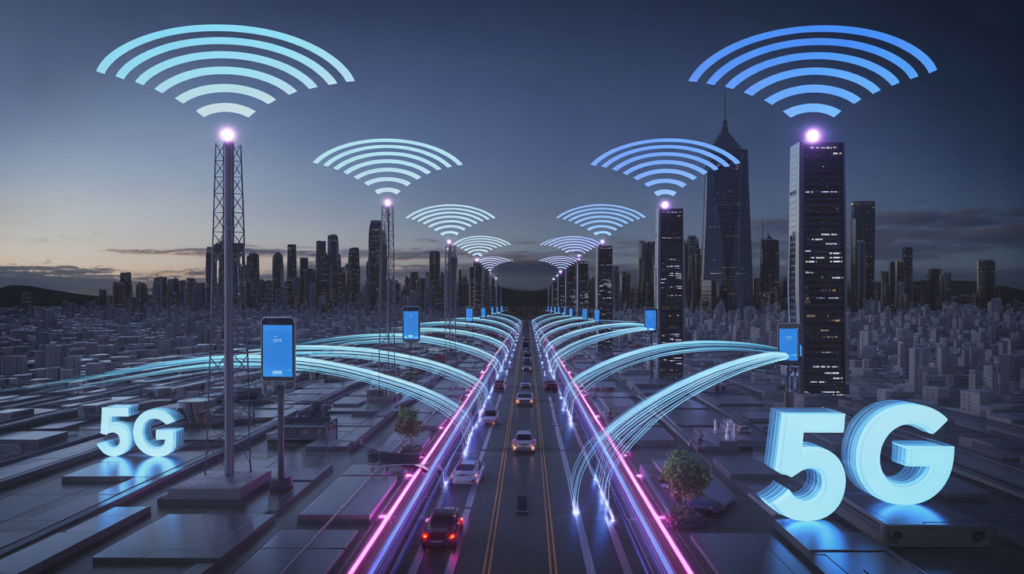
The most noticeable advantage of 5G is speed. While 4G networks offer speeds up to 100 Mbps, 5G networks can deliver peak speeds of 1–10 Gbps.
How 5G speed impacts daily life:
- Stream 4K or 8K videos without buffering
- Download large files in seconds
- Experience smooth cloud gaming
- Use real-time AR and VR applications
As the GSMA reports, 5G networks will continue expanding globally through 2030, with billions of subscribers expected.
Source: https://www.gsma.com (Search “5G trends”)
Fast internet is only the beginning—5G is built to support technologies that demand speed plus stability.
2. Ultra-Low Latency: The Real Game Changer
Latency refers to how long it takes for data to travel between two points. With 4G, latency usually averages around 30–50 ms.
With 5G? It drops to 1–10 ms, making it nearly instantaneous.
Why low latency matters:
- Remote surgeries can be performed with precision
- Autonomous vehicles can respond in real time
- VR and AR can work without motion lag
- Industrial robots can operate seamlessly
This is especially critical for mission-critical operations in manufacturing, healthcare, and transportation.
3. Supporting the Internet of Things (IoT) Revolution
5G is designed to connect massive numbers of devices at once — up to 1 million devices per square kilometer.
This capability is essential for the growing IoT ecosystem.
5G-powered IoT examples include:
- Smart home devices
- Smart city sensors
- Energy monitoring systems
- Wearable health trackers
- Connected security systems
IDC predicts that IoT devices will exceed 30 billion globally by 2030, and 5G networks are the backbone for this expansion.
Source: https://www.idc.com (Search “IoT forecast”)
4. 5G in Smart Cities
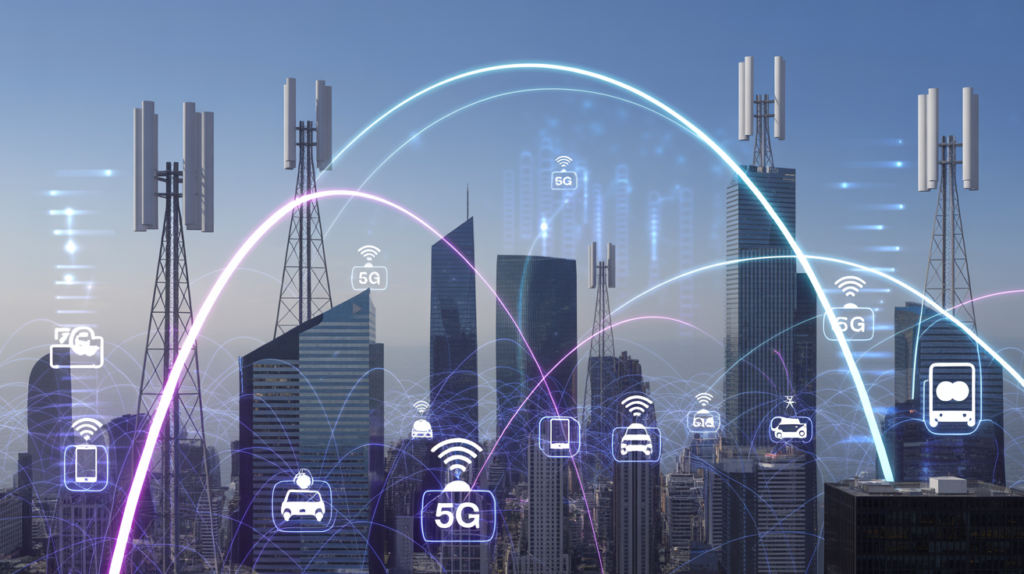
Cities across the USA are already adopting 5G to enhance efficiency, safety, and infrastructure.
5G enables:
- Intelligent traffic management
- Real-time public transportation data
- Smart lighting and energy systems
- Faster emergency response
- Enhanced public safety networks
Cities like Atlanta, Chicago, and New York are leading the development of 5G-enabled urban technology.
5. Revolutionizing Healthcare
Healthcare is one of the industries where 5G has the most transformative impact.
Key uses:
- Remote surgeries
- Smart hospital devices
- Wearable health monitoring
- Real-time patient tracking
- AI-powered medical diagnostics
The U.S. Department of Health and Human Services notes that advanced connectivity can significantly improve telehealth services and patient outcomes.
Source: https://www.hhs.gov/telehealth
The low latency and high bandwidth of 5G help doctors and medical teams deliver more accurate, efficient, and life-saving care.
6. Driving Innovation in Education
The COVID-19 pandemic highlighted the importance of high-speed internet for education. 5G aims to fix many limitations of online learning.
Benefits:
- Lag-free video classes
- Real-time collaboration tools
- Virtual labs and simulations
- AR lessons for immersive learning
- Equal access to high-speed connectivity
Rural areas in the USA especially stand to gain, as 5G improves mobile broadband coverage where wired connections are limited.
7. Enhancing Entertainment, Gaming, and Media
Entertainment is one of the first sectors to feel the impact of 5G.
With 5G, users get:
- Seamless 4K/8K streaming
- Cloud gaming without lag (Xbox Cloud, Nvidia GeForce Now)
- AR/VR interactive experiences
- Live event streaming with zero delay
5G unlocks experiences that were previously impossible on mobile networks.
8. Transforming Business Operations
Businesses across the USA are rapidly adopting 5G to improve productivity and reduce operational costs.
5G enhances:
- Cloud computing
- Robotics and automation
- AI data processing
- Real-time analytics
- Remote work capabilities
Companies using 5G can operate faster, reduce downtime, and offer more innovative services to customers.
9. 5G and the Future of Autonomous Vehicles
Self-driving cars need to communicate instantly with traffic systems, pedestrians, and other vehicles.
This requires extremely low latency — which only 5G provides.
5G supports:
- Vehicle-to-vehicle communication (V2V)
- Vehicle-to-infrastructure communication (V2I)
- Real-time road hazard alerts
- Automated driving assistance
The U.S. Department of Transportation recognizes 5G as a critical technology for the future of autonomous transportation.
Source: https://www.transportation.gov
10. Improving Reliability and Network Performance
5G networks use advanced technologies like:
- Network slicing
- Massive MIMO
- Beamforming
These innovations improve:
- Signal strength
- Coverage
- Efficiency
- Reliability
Network slicing allows operators to create custom mini-networks for specific industries such as healthcare, finance, or gaming — each with optimized performance requirements.
11. Economic Impact of 5G in the USA
According to a Qualcomm study, 5G is expected to generate:
- $1.5 trillion in economic output
- Over 4.5 million new jobs
by 2035.
This growth comes from:
- New businesses
- Technology startups
- Innovation in manufacturing
- Increased consumer demand
5G is not only a technical upgrade — it is a major economic catalyst.
12. Challenges to 5G Adoption
Despite its potential, 5G also faces hurdles:
Challenges include:
- High infrastructure costs
- Device compatibility limitations
- Slower deployment in rural areas
- Public misconceptions about 5G
- Regulatory and spectrum management issues
However, with ongoing investment from major carriers like Verizon, AT&T, and T-Mobile, coverage continues to improve nationwide.
Conclusion: 5G Is the Future of Connectivity
5G technology is transforming how people and businesses connect, communicate, and operate. Its ultra-fast speeds, low latency, and support for millions of devices are powering innovations in healthcare, transportation, entertainment, and beyond.
As more carriers expand their 5G networks and more devices become compatible, the USA will experience a new era of digital transformation—one built on smarter systems, faster communication, and highly connected ecosystems.
5G is not just the future—it is here, and it is already reshaping modern connectivity.
Can you be more specific about the content of your article? After reading it, I still have some doubts. Hope you can help me.
Reading your article helped me a lot and I agree with you. But I still have some doubts, can you clarify for me? I’ll keep an eye out for your answers.
I don’t think the title of your article matches the content lol. Just kidding, mainly because I had some doubts after reading the article.
I don’t think the title of your article matches the content lol. Just kidding, mainly because I had some doubts after reading the article.
Thanks for sharing. I read many of your blog posts, cool, your blog is very good.