
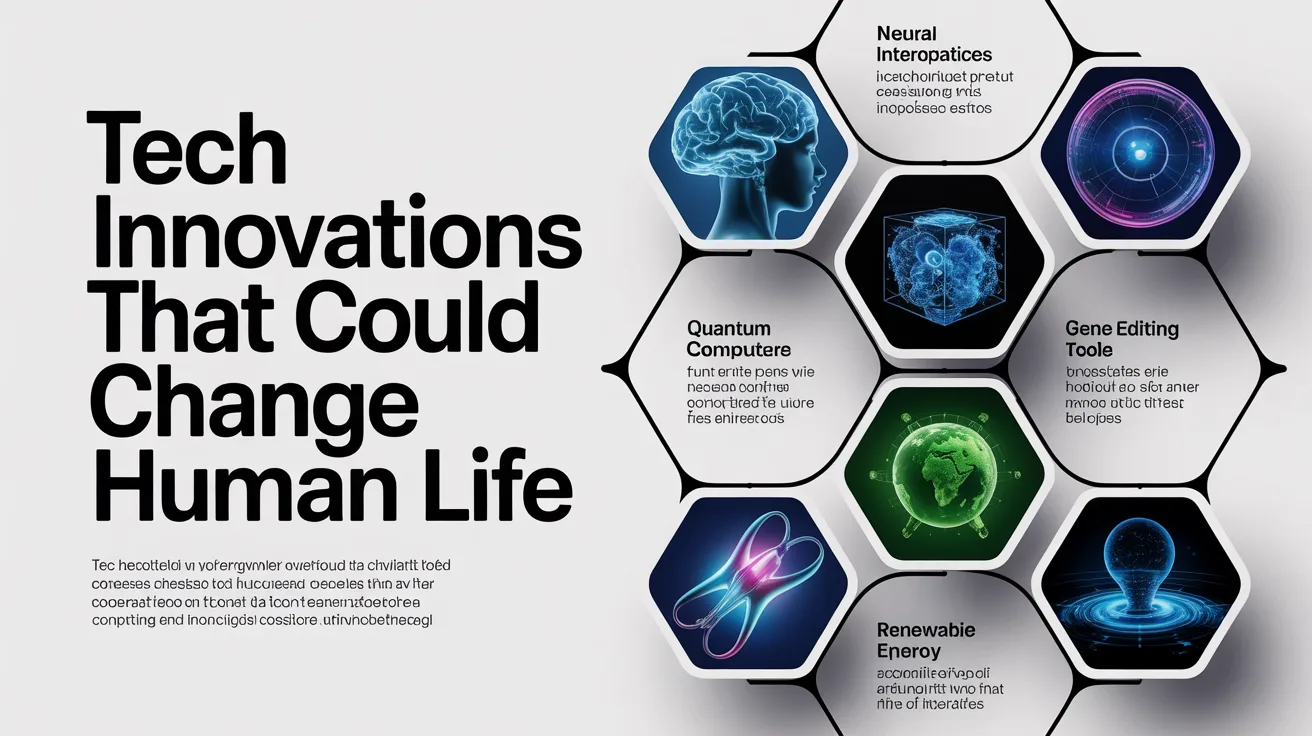
Technology has always shaped human civilization—from the invention of the wheel to the rise of the internet. Today, we are entering an era where technological innovation is accelerating faster than ever before. Emerging technologies are not only transforming industries but also redefining how we live, work, communicate, and care for our planet.
In this article, we explore tech innovations that could change human life in the coming years. These advancements have the potential to improve healthcare, enhance productivity, solve global challenges, and reshape everyday experiences.
1. Artificial Intelligence and Machine Learning
Artificial Intelligence (AI) is already influencing daily life, but its future impact could be even more transformative.
ALSO CHECK:
How AI could change human life:
- Faster and more accurate medical diagnoses
- Personalized education and learning paths
- Smart assistants managing daily tasks
- Improved disaster prediction and response
- Advanced automation in industries
AI systems can analyze vast amounts of data quickly, helping humans make informed decisions. In healthcare, AI-powered diagnostics can detect diseases earlier, improving treatment outcomes. In business, AI-driven analytics enhance productivity and innovation.
However, responsible AI development is essential to ensure fairness, transparency, and privacy.
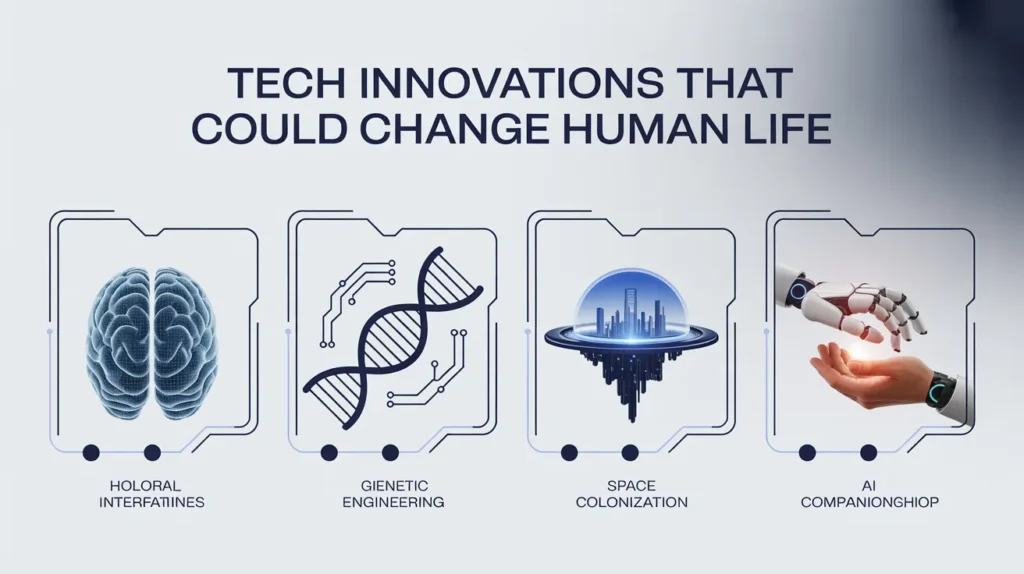
2. Biotechnology and Gene Editing
Advancements in biotechnology are revolutionizing medicine and agriculture.
Key innovations:
- CRISPR gene-editing technology
- Personalized medicine
- Lab-grown organs
- Disease-resistant crops
Gene editing could help eliminate certain genetic disorders and improve food security worldwide. Personalized medicine allows treatments tailored to individual genetic profiles, increasing effectiveness and reducing side effects.
While promising, ethical considerations and strict regulations are necessary to ensure safe and responsible use.
3. Renewable Energy and Clean Technology
Climate change remains one of the biggest global challenges. Renewable energy innovations are critical for creating a sustainable future.
Transformative technologies include:
- Advanced solar panels
- Wind energy optimization
- Green hydrogen fuel
- Energy storage breakthroughs
Battery innovation, in particular, could improve electric vehicle performance and make renewable energy more reliable. Clean technology has the potential to reduce carbon emissions and create new economic opportunities.
Sustainable innovation is not just environmentally beneficial—it also supports long-term global stability.
4. Quantum Computing
Quantum computing represents a major leap beyond traditional computers.
Potential impacts:
- Solving complex scientific problems
- Accelerating drug discovery
- Enhancing cybersecurity
- Optimizing logistics and supply chains
Unlike classical computers, quantum computers can process vast numbers of possibilities simultaneously. Although still in development, this technology could revolutionize fields like physics, medicine, and artificial intelligence.
5. Extended Reality (AR, VR, and Mixed Reality)
Extended Reality (XR), which includes Augmented Reality (AR) and Virtual Reality (VR), is transforming how people interact with digital content.
Applications include:
- Virtual classrooms and training simulations
- Remote collaboration in 3D environments
- Immersive entertainment experiences
- Virtual tourism
In education and professional training, XR allows users to practice skills in safe, simulated environments. This innovation enhances engagement and improves learning outcomes.
6. Autonomous Vehicles and Smart Transportation
Self-driving cars and smart transportation systems are rapidly advancing.
Benefits may include:
- Reduced traffic accidents
- Improved mobility for elderly and disabled individuals
- Lower transportation costs
- More efficient urban planning
Autonomous systems rely on AI, sensors, and real-time data processing. While challenges remain in safety and regulation, smart transportation could significantly improve daily commuting and logistics.
7. Internet of Things (IoT) and Smart Living
The Internet of Things connects everyday devices to the internet, enabling automation and data sharing.
Examples of IoT in daily life:
- Smart home devices
- Wearable health monitors
- Connected appliances
- Smart city infrastructure
IoT technology can improve convenience, energy efficiency, and safety. Smart homes can optimize lighting and temperature, while wearable devices monitor health metrics in real time.
However, cybersecurity and data privacy remain important considerations.
8. Advanced Robotics
Robotics is moving beyond industrial factories into homes, hospitals, and service industries.
Emerging applications:
- Robotic surgery
- Warehouse automation
- Elderly care robots
- Disaster-response robots
Robots can perform repetitive or dangerous tasks, reducing human risk and increasing efficiency. As robotics becomes more advanced, collaboration between humans and machines will become more common.
9. Brain-Computer Interfaces (BCIs)
Brain-computer interface technology aims to create direct communication between the human brain and digital devices.
Potential future uses:
- Assisting people with paralysis
- Restoring communication abilities
- Enhancing cognitive research
- Advanced prosthetics control
Although still in early stages, BCIs could dramatically improve quality of life for individuals with neurological conditions.
10. Space Exploration and Commercial Space Travel
Space technology is entering a new era driven by private companies and global collaboration.
Potential life-changing impacts:
- Satellite internet for remote areas
- Advanced climate monitoring
- Space-based research
- Future resource exploration
Satellite technology already supports navigation, weather forecasting, and communication. Expanding access to space may unlock new scientific discoveries and global connectivity solutions.
11. 3D Printing and Advanced Manufacturing
3D printing is revolutionizing how products are designed and produced.
Transformative possibilities:
- Custom medical implants
- Affordable housing construction
- Rapid prototyping
- On-demand manufacturing
By reducing waste and transportation costs, 3D printing can make manufacturing more sustainable and efficient.
12. The Importance of Responsible Innovation
While these innovations offer enormous promise, responsible development is crucial.
Key considerations:
- Ethical use of emerging technologies
- Data privacy and cybersecurity
- Environmental sustainability
- Accessibility and inclusivity
Technology should improve human life without creating unnecessary risks or inequalities. Collaboration between governments, researchers, and businesses is essential to ensure that innovation benefits society as a whole.
The Human Factor in Technological Progress
Despite rapid technological change, humans remain at the center of innovation. Technology is a tool—its impact depends on how it is designed and used.
Education, digital literacy, and ethical awareness will determine whether these innovations improve global well-being or create new challenges.
Final Thoughts
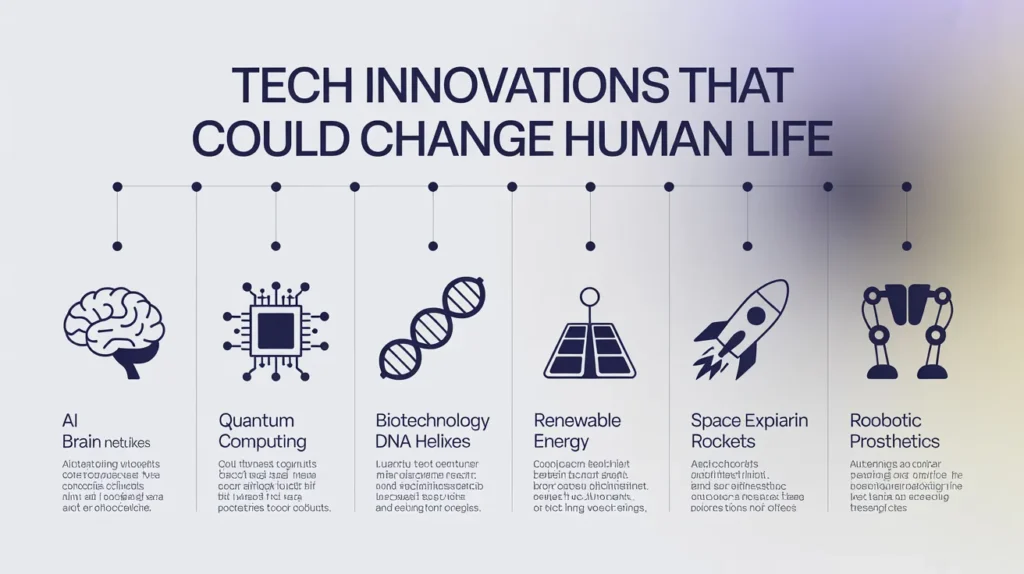
Tech innovations such as AI, biotechnology, renewable energy, quantum computing, robotics, and smart infrastructure have the potential to fundamentally change human life. They promise better healthcare, cleaner energy, smarter cities, and more efficient industries.
However, the future of these technologies depends on responsible development, thoughtful regulation, and inclusive access. When guided by ethical principles and human-centered design, technological innovation can become one of the greatest forces for positive change in history.
The coming decade will likely redefine what is possible—and how humanity adapts to a rapidly evolving digital world.
1 thought on “Tech Innovations That Could Change Human Life”